
(And How to Avoid Them) Performance Physiotherapy for Hybrid Athletes – by ADAPT Recharge
HYROX isn’t just running.
It isn’t just strength either.
It’s the brutal combination of both.
Ask anyone who has crossed a HYROX finish line and they’ll tell you: the real challenge isn’t one station or one run — it’s executing demanding strength movements after your legs are already burning, then repeating that cycle eight times.
That’s what makes HYROX so effective. It’s also exactly why it creates a unique pattern of injuries in hybrid athletes.
At ADAPT Recharge, we consistently see three injuries show up during HYROX preparation — especially in the final weeks before race day when athletes push the hardest.
Understanding why these injuries happen and how to prevent them can make the difference between showing up ready… or showing up hurt.
Why HYROX Training Is Hard on the Body
Most HYROX injuries don’t happen suddenly.
They build slowly.
Unlike traditional sports injuries, HYROX athletes rarely get hurt from one bad lift or one bad run. Instead, the body accumulates stress week after week until a tissue finally exceeds its capacity.
HYROX training combines two demands that rarely overlap:
• Increasing running volume
• High-rep strength work under fatigue
Both of these stress the same tissues:
- hips
- hamstrings
- knees
- lower back
When recovery, strength balance, and programming aren’t managed carefully, overuse injuries follow.
Three patterns almost always appear before injury:
1️⃣ Running fatigue spills into strength work
Technique breaks down and other muscles compensate.
2️⃣ Weak posterior chain
Glutes and hamstrings can’t support sled pushes, lunges, and hip extension under fatigue.
3️⃣ Aggressive training blocks
Too much intensity without planned recovery weeks.
Keep these patterns in mind — they show up in every injury we’re about to cover.

Injury #1: Hip Flexor Overload
Why It Happens
Your hip flexors lift the leg during every running stride.
But during HYROX training, they’re also heavily involved in:
- sled pushes
- lunges
- explosive transitions
- running intervals
That’s a lot of work for one muscle group.
When running volume increases at the same time as sled and strength training, the hip flexors suddenly carry a massive workload.
If the glutes aren’t strong enough to share the load, the hip flexors overwork and eventually become irritated.
Another major factor?
Modern lifestyle.
Athletes who sit most of the day often start training with already shortened hip flexors, increasing strain once they begin high-intensity sessions.
Warning Signs
Watch for:
• A deep ache at the front of the hip
• Pain during running, lunges, or sled pushes
• Stiffness after sitting
• Pain that disappears during warm-up but returns later
These are early overload signals.
How to Prevent It
1. Increase running volume slowly
Limit increases to 5–10% per week when also adding strength work.
2. Strengthen the glutes
Prioritize exercises like:
- hip thrusts
- Romanian deadlifts
- split squats
These reduce the workload placed on the hip flexors.
3. Improve hip mobility
Daily hip flexor and hip extension mobility can dramatically reduce stress.
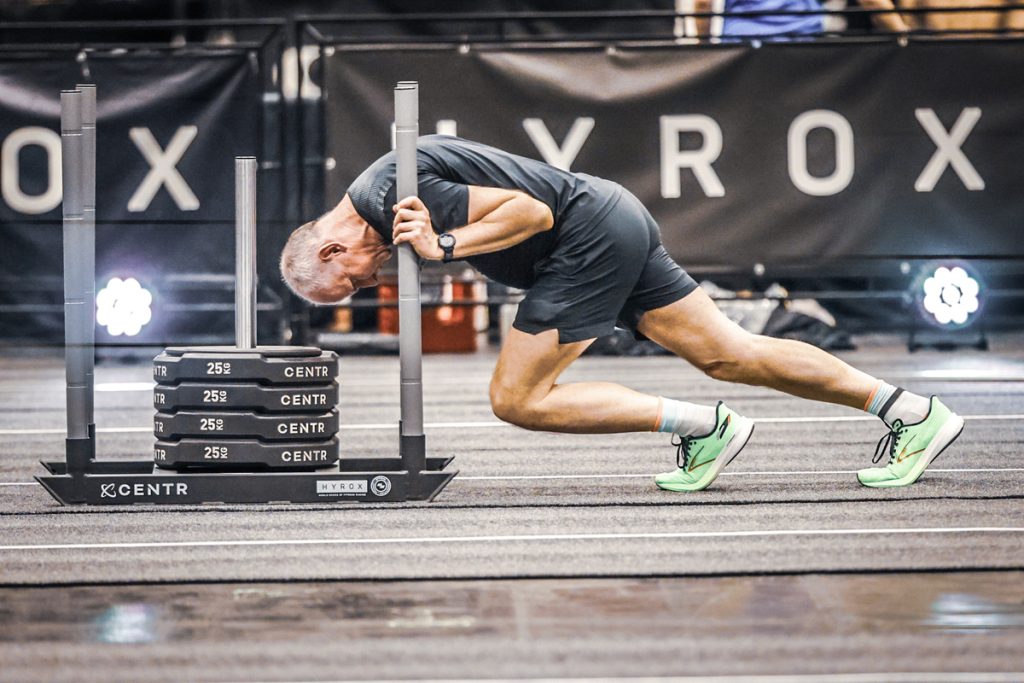
4. Watch your sled push posture
An exaggerated lower-back arch during sled pushes usually means your hip flexors are compensating.
Injury #2: Hamstring Strains
Hamstring injuries are among the most frustrating injuries in sport.
They heal slowly.
They reoccur easily.
And in HYROX athletes, they often happen during speed work or race simulations.
Why Hybrid Athletes Are At Risk
The hamstrings serve two major functions:
• Hip extension (deadlifts, lunges, sled pulls)
• Eccentric braking during running
When athletes perform speed work after heavy strength sessions, the hamstrings are already fatigued.
That fatigue dramatically increases injury risk.
Previous hamstring or Achilles injuries also increase the likelihood of another strain.
Key Risk Factors
- Heavy posterior chain training followed by speed work
- Lack of eccentric hamstring training
- Strength imbalances between legs
- Insufficient recovery weeks
How to Prevent Hamstring Strains
1. Add eccentric hamstring training
The gold standard exercise:
✔ Nordic Hamstring Curls
They have some of the strongest evidence in injury prevention.
2. Train both hamstring functions
Combine:
Hip-dominant work
- RDLs
- Hip thrusts
Knee-dominant work
- leg curls
- Nordics
3. Separate heavy strength and speed days
Avoid stacking maximal lifting sessions and speed intervals within 24 hours.
4. Use unilateral training
Exercises like:
- single-leg RDLs
- step-ups
help expose imbalances that increase injury risk.
5. Schedule deload weeks
Every 3–5 weeks, reduce volume or intensity.
Recovery is part of training.
Injury #3: Patellar Tendon Pain (HYROX Knee Pain)
HYROX places constant stress on the knees.
The patellar tendon connects the kneecap to the shin and transfers force when you extend the knee.
During a HYROX race, it’s under heavy demand from:
- running impact
- wall balls
- sled pushes
- lunges
Often all while the quads are already fatigued.
Over time, the tendon simply absorbs more load than it can tolerate.
Additional Hidden Cause: Limited Ankle Mobility
When ankle mobility is poor:
- the heel lifts during squats and wall balls
- the knee shifts forward excessively
- stress on the patellar tendon increases
How to Protect Your Knees
1. Build quad tolerance
Better options than traditional squats:
- eccentric step-downs
- split squats
- loaded step-ups
2. Improve ankle mobility
Daily calf and ankle work should be part of your warm-up.
3. Strengthen the lateral hip
Weak hip abductors cause the knee to collapse inward.
Add:
- banded walks
- clamshells
- single-leg exercises
4. Break up wall ball sets
Instead of grinding through 50+ reps with poor form, use smaller sets.
Fatigue drastically increases knee stress.
5. Act on early symptoms
Morning knee stiffness or pain going downstairs are early tendon warnings.
Address them early.
The Most Dangerous Time Before a HYROX Race
The final 2–3 weeks before race day.
This is when athletes start doubting their preparation and try to squeeze in extra work.
That’s when preventable injuries happen.
A proper taper should reduce training volume — not intensity.
Smart Taper Strategy
Reduce training volume by 30–40%
But maintain some race-pace intensity.
What To Focus On
✔ Maintain light posterior chain strength
✔ Prioritize sleep and recovery
✔ Practice technique when fresh
✔ Avoid new exercises
✔ Avoid testing max lifts
The most common mistake?
Running a full race simulation the week before the race and arriving fatigued.
Final Takeaway
The three most common HYROX injuries:
• Hip flexor overload
• Hamstring strains
• Patellar tendon pain
All share the same root causes:
- increasing load too quickly
- insufficient posterior chain strength
- poor recovery planning
The athletes who arrive at race day in peak condition aren’t the ones who trained the hardest.
They’re the ones who trained the smartest.
Ready to Race Pain-Free?
If you’re dealing with:
- hip pain
- hamstring tightness
- knee discomfort
- lower back fatigue
during HYROX preparation, don’t wait until race week.
The team at ADAPT Recharge works with hybrid athletes every day to identify the cause of pain and keep you training.
Book an assessment today and arrive at the start line ready.
Connect with Train Adapt online
Want daily workout clips, member spotlights, and behind‑the‑scenes looks at life inside the gym? Follow Train Adapt on social to stay plugged into the community and get extra motivation between classes.
- Instagram: https://www.instagram.com/trainadapt/
- Facebook: https://www.facebook.com/trainadapt/