
Pelvic floor dysfunction in athletes can limit performance. Learn symptoms, causes, and how to improve strength, stability, and control.
You train hard. You recover well. You’ve dialed in your sleep, nutrition, mobility — all of it.
But there’s one system almost nobody is screening, and the research says it’s affecting nearly half of competitive athletes.
The pelvic floor.
Not just a postpartum thing, a “leakage” thing, or a women’s thing. It’s showing up in male lifters, endurance runners, HYROX competitors, and pretty much anyone putting serious load through their body regularly. And when it’s off, it quietly taxes your performance, your stability, and your longevity.
Here’s the short version of what you actually need to know.
What It Actually Is
Your pelvic floor is a hammock of muscles stretched across the base of your pelvis. It has three jobs that matter to you as an athlete:
1. Keeps things closed under pressure — no leaking on jumps, sprints, heavy pulls 2. Holds your organs in position against gravity and training stress
3. Acts as the floor of your deep core — the one no one trains
That third one is the performance piece. Your pelvic floor works with your diaphragm and deep abs as one coordinated pressure system. When the system leaks — literally or figuratively — your body compensates somewhere else. Usually in your low back, your hips, or your hip flexors. Sound familiar?
The Reality Check
MoA study at the 2024 World Athletics U20 Championships screened 325 elite youth athletes. 43.7% had pelvic floor dysfunction. 29% of the guys. 88% had never been screened. 95% had never sought care.
NCAA athletes who screened positive? 92% said it was significantly affecting their performance and quality of life.
And for male athletes: higher training volume = higher risk. The harder you train without addressing this, the more likely you are to hit a wall.
This isn’t a rare problem. It’s an everywhere problem. We just don’t name it.
Two Problems. Opposite Solutions.
Here’s where most people mess up.
Underactive (weak):
Leaking on sneezes, jumps, heavy lifts
Core instability, back pain
Fix: strengthen, properly
Overactive (too tight):
Pelvic pain, hip tightness, tailbone pain
Urinary urgency, painful sex
Fix: downtrain. Release. Breathe. This is the important part: doing Kegels on an overactive floor makes it worse. That’s why assessment has to come first. You can’t out-train a problem you haven’t identified correctly.
What Actually Works
If you have any of the signs (leakage, pelvic or hip pain, stubborn back issues, urinary urgency, or performance limits you can’t explain), the sequence is:
1. Get assessed. Pelvic floor PT or a validated screen like the Cozean Protocol.
2. Train accordingly. Strengthen if underactive. Downtrain if overactive. Not the other way around.
3. Integrate it with core + breath. Isolated Kegels aren’t enough — the research is clear that integrated programs beat isolated ones every time.
4. Load it functionally. End goal is reflexive coordination under real training — carries, planks, landings, sport-specific movement.
A 2026 pilot study put female athletes through a 12-week integrated program. Pelvic pain dropped from 4.8 to 1.6. 85% reported minimal or no leakage. Activity interference scores cratered from 6.85 to 1.20.
That’s not incremental. That’s life-changing.
3 Things You Can Start This Week
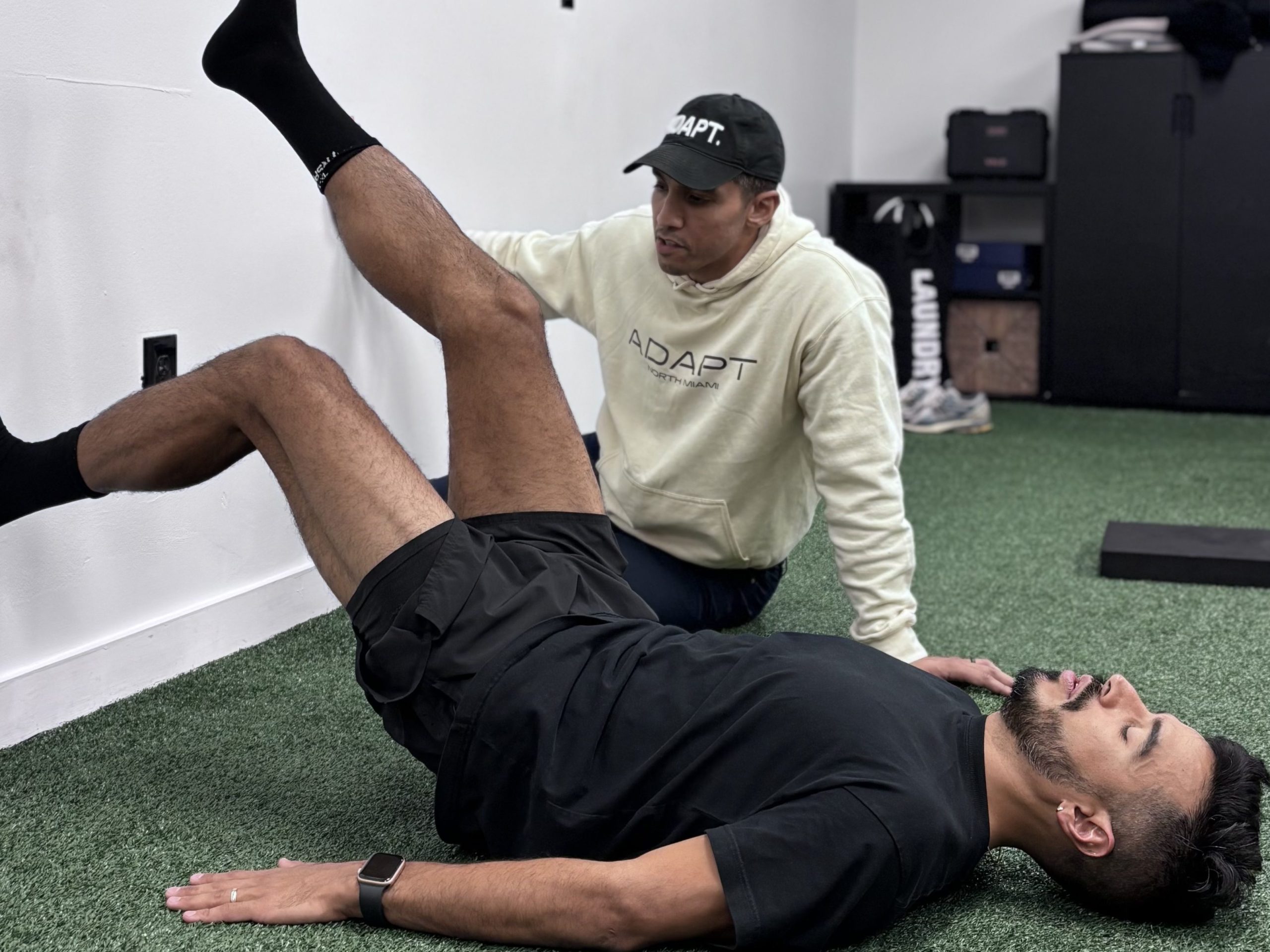
1. Practice 360° breathing. Lie on your back. Inhale through your nose and expand into your lower ribs (not just your belly). Exhale long and slow. Your pelvic floor should release on the inhale and naturally engage on the exhale. 5 minutes a day.
2. Stop doing random Kegels. Especially if you have any pain or tightness. You might be stacking tension on a system that needs release.
3. Get assessed. Seriously. This isn’t a guess-and-check system.
What makes Recharge different is the environment around it. Your recovery doesn’t happen in a quiet clinic that never sees a barbell, a sled, or a sprint drill—it happens right inside a performance‑driven facility.
That means:
- Your recovery team understands how you train.
- Your program can easily adjust as your goals evolve.
- Communication between training and recovery stays tight.
- You can go from the training floor to your recovery appointment in the same visit.
This integrated setup is ideal if you care about performance, longevity, or simply feeling your best day to day.
This is the most underdiagnosed performance limiter in active adults. It quietly drains your training, your stability, and your capacity to keep showing up — and it responds to the right approach faster than most people think.
If any of this hit home, the next step isn’t another YouTube rabbit hole. It’s a proper assessment and a plan that matches your specific type of dysfunction.
Come learn more in person. We’re hosting a Pelvic Floor Lunch & Learn alongside our annual Moms & Mimosas event at ADAPT Recharge — May 2nd at 10AM. Every attendee walks out with a free 4-week starter program they can implement the same day.
Connect with Train Adapt online
Want daily workout clips, member spotlights, and behind‑the‑scenes looks at life inside the gym? Follow Train Adapt on social to stay plugged into the community and get extra motivation between classes.
- Instagram: https://www.instagram.com/trainadapt/
- Facebook: https://www.facebook.com/trainadapt/